

The Creative Abolitionist | Vol. 2
The Creative Abolitionist | Vol. 2
A newsletter focused on the intersections of abolition, youth organizing, and creativity from the desk of Lincoln Mondy, Program Officer at Andrus Family Fund.

If this is your first missive, welcome! As I wrote in the inaugural volume, The Creative Abolitionist is my line in the sand declaring that tearing down structures leaves room for new growth—a barren concrete foundation for us to sprout through the cracks and sow the worlds we’ve dreamt up.
For this volume, I focus on a recent staff and board learning trip to the Equal Justice Initiative’s Legacy Sites in Montgomery, Alabama.
Content notes: Racial terror and violence
Growing up going to a Black church in Texas meant that, without fail—every summer break, you knew you were going on some type of learning trip with your youth group—and the trip would probably be about slavery.
While my peers were counting down the days to Disney World, or a beach vacation, I knew I would probably wind up at a plantation in Louisiana. Or in Galveston where Black people who were enslaved learned of the Emancipation Proclamation two-and-a-half years late. Or in Memphis to crowd around the motel Black people know all too well.
I went on trips like these with my church youth group between the ages of 6 and 13—certainly not a time in my life when I was begging to be packed in the church van for long, hot road trips to destinations where it felt like mourning was all around me.
That is a shared experience for many Black folks: our elders yearning for us to “know our history.” It didn’t seem like a choice, but rather an instinct laced with fear that wasn’t exclusive to those summer trips. It was as if the fear, the hurt, and the passed-down and newfound trauma forced my Black elders to want to shield me by passing down that same fear. Especially before I got too big for my britches, before I had a chance to generate an audacity that, for them, was dangerous for someone who looked like me. It’s like there was a preverbal clock above all of our heads, and these trips, which teetered on scare tactics (i.e., having us crawl through the small openings our ancestors contorted their bodies through along the Underground Railroad) were the buzzer beaters.
I know this is not a unique experience, and I do not blame my elders for their perspectives or style of passing down history. What else was at their disposal? If I didn’t have those Black church youth group trips, I would only be left with sanitized Texas history books and media littered with fantasies of good “slave owners.’” Or you know, the “field trip” my mostly white public elementary school in Farmersville, Texas took me on to a nearby cotton field. There, we not only learned how cotton was picked, but we had to pick the cotton for competition! Yes, mostly white kids and me and my skinfolk in the field, rushing to pick cotton to receive a prize for the heaviest bag. There weren’t moments of silence. There weren’t solemn sermons. There were no tears. Regarding who won the competition, I can’t say. My Granny Bettye and her red van came blaring to the field to pick me up after she got word about the planned activities.
Those were the experiences lingering with me as the Andrus Family Fund staff and board landed in Montgomery last month. We chose to visit The Legacy Sites to deepen our learning regarding the historical connection between enslavement, racial terror, and current policies of mass incarceration and family separation.
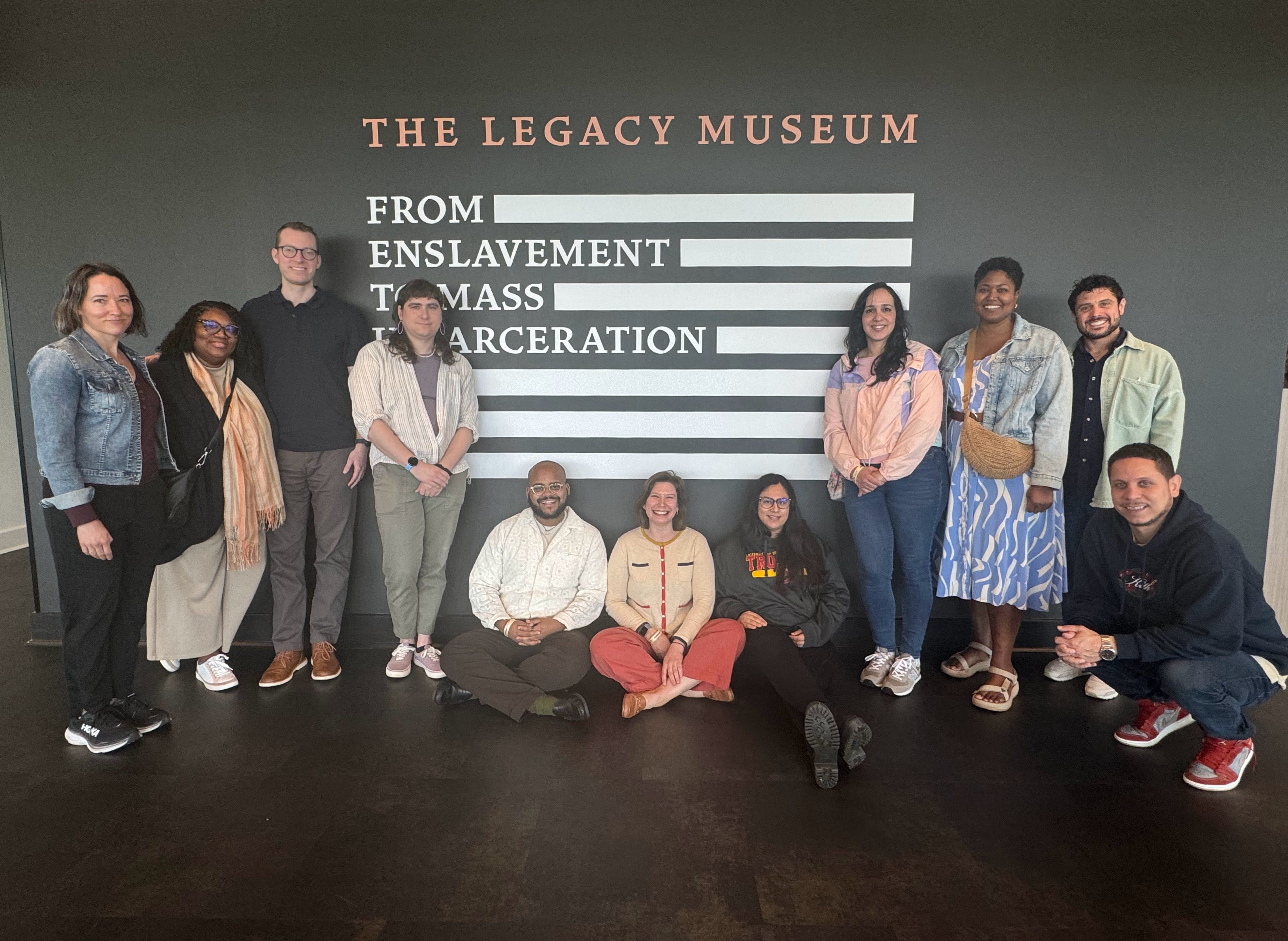
On those summer trips with my church youth group, we learned and spoke about enslavement, lynching, and Jim Crow all in the past tense. We focused on the perseverance stories and glimmers of light that offer a brief reprieve from the horrors. We didn’t talk about connections or continuations. We didn’t talk about colonialism or capitalism. Prisons or punishment. Everything had a period, an end.
That’s what EJI’s Legacy Sites do incredibly well. Instead of focusing on the atrocities of enslavement and racial terror as artifacts of the past, the museum and connected sites frame these practices as the foundation for our current realities. Visitors are not left to mindlessly digest trauma. They are empowered to see how it’s all interconnected, guided by the dehumanizing myths of racial difference that have seeded the ground for white supremacy to endure. This is not by accident if you’re aware of the Equal Justice Initiative’s long, active, and vital role in challenging prisons and punishment in this country. Since 1989, EJI has represented people who have been illegally convicted, unfairly sentenced, or abused in state jails and prisons. Walking through the exhibit, it’s hard not to feel the same sense of urgency, care, and commitment that is surely required by their staff lawyers in order to work in the bowels of our punishment system—death row.
Even as the museum spans a massive timeline (400 years), the space erases those periods that transform the atrocities of the past into long-gone sins that have no lingering scents by offering truth-telling commas, semicolons, and asterisks for further consideration.
As you move through time, words and connections are clear. Precise language is offered to unlock individual aha moments. Language is also used to clear up popular narratives that have a deep-seated hold on our collective consciousness. For instance, when you hear the words "the Great Migration," you may, like myself, have mental images of jazz, artistry, and bravery. Black people moving to the big city for new opportunities, making a way out of no way. Sure, but the truth-telling facts inside the museum challenge you to reconsider the migration for what it was: refugees fleeing racial terror.
EJI rightfully understands that you can educate a person all day long, but if you don’t provide accurate language that can break through propaganda, intentional silos, and vague platitudes, it’s a fool's errand. Space is given to challenge commonly-held shared language so that even if a person's entire life isn’t transformed by the experience, at least the intent of the learning can leave through words.
The museum is almost in a 1on1 conversation with you, cataloging all the historical events you should reconsider and reflect on. It may be known as the Transatlantic Slave Trade, but it was, more accurately, the global human trafficking of 13 million people. Reconstruction? Oh yeah, the 12-year period following the Civil War where a well-funded and power-gripping white upper class worked overtime to enshrine white supremacy into law. Yes, the 13th Amendment was passed in 1865 and does outlaw slavery, but the organized and well-funded white resistance allowed it to flourish for another century. Oh, and here is a picture of the 13th Amendments’ exception to slavery and involuntary servitude: prison labor.
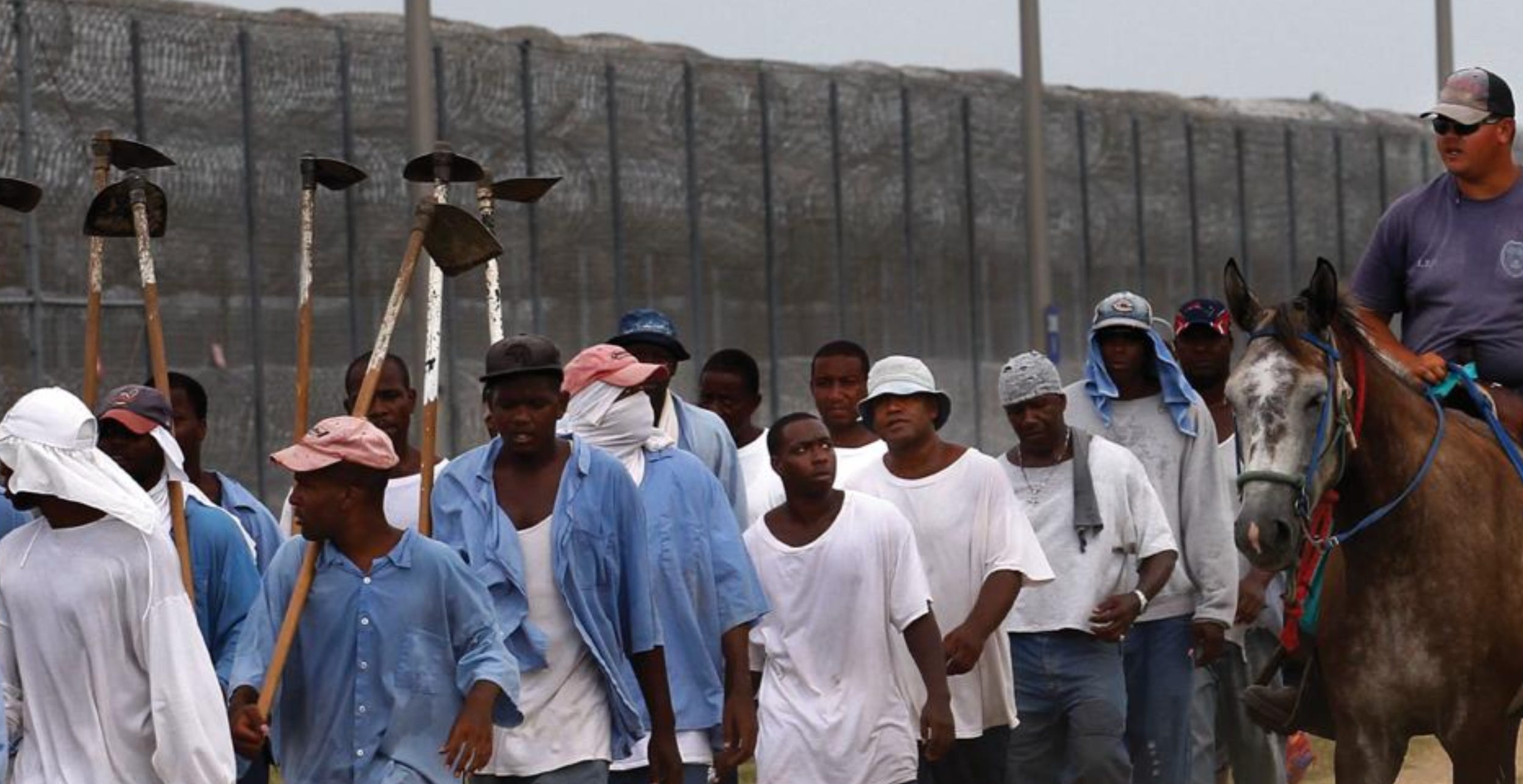
The narrative throughout the experiences of enslavement, racial terror lynching, segregation, and mass incarceration is clear and consistent. The design is both Brutalist and organic at the same time. There aren’t sharp corners in the exhibition that curtail off sections—there is only one path in and one path out. You begin in a dark room, underwater, with waves crashing over you via visceral audio, visual, and lighting design. You’re reminded that in addition to the 13 million Africans who survived their kidnapping by boat, nearly 2 million souls died horrific deaths in vast, dark seas along the way. While the design asks you not to look away, the wide halls and variety of learning materials around the room (e.g.,video, film, holograms, text) offer reprieve when you need it.
As you navigate the space, you unexpectedly go from rooms with supersized “auction pamphlets” filled with advertisements from slave owners describing the bodies and behavior of their state-designated property to a theater asking you to honor Mamie Till’s wishes and not look away at how racial terror and white supremacy disfigured her son, Emmett. Then you’re guided all the way up to mass incarceration. Unfortunately, it doesn’t feel like a leap at all. After the mass incarceration era, the path leads to a majestic, copper-ceiling room asking you to pause and reflect. The last room is a colorful art gallery right before a bustling museum lobby—another intentional design choice focused on acknowledging and honoring the horror you confronted.
When I exited the Legacy Museum, I was comforted by the dozens of Black church youth groups in matching t-shirts I had to maneuver through. I was comforted thinking about the thousands of vans filled with Black children, who are being failed by systems supposedly concerned with their education and welfare, arriving in Montgomery for their summer trips.
Maybe they will not step out of the van with the same enthusiasm of a holiday morning, but I do know they will be offered truth-telling that can unlock an individual journey of mourning and commitment and, ultimately, usher in a collective reckoning.


Below are opportunities from AFF and our partners. If your organization decides to submit for any opportunity shared here, know that the AFF team is available for questions, brainstorms, and submission reviews if helpful.
April 30 deadline: The Nathan Cummings Foundation has an open call for two funding opportunities: grants and program-related investments (PRIs). Proposals must align with NCF's interconnected goals of racial justice, economic justice, and/or environmental justice.
June 4 deadline: There is a paid council-member opportunity for people 18 and older impacted by the juvenile legal system, or people with impacted family members. The Youth and Family Council would inform the development and work of the Center for Reducing Racial and Ethnic Disparities in Juvenile Justice.


Meet Board Member Lucero Noyola | AFFund.org
I’m excited to share this Montgomery reflection from one of our newest AFF board members! Lucero and I started our AFF experiences around the same time last summer, and it’s been nice to have a new-to-all-this buddy. I’m even more grateful for the learning and contagious energy Lucero brings to the work. In this Q&A, Lucero shares more about her journey to the board and her learnings from Montgomery.
For a long time in my work, I was a reformist. It wasn’t until I spent a lot of time working within systems and nonprofits that I realized that no matter how much you want to change a system from within, there’s always going to be a structure that creates boundaries on how much you can do. That’s really when I took more of a macro-level view, which began to align with abolitionism — realizing that these systems cannot be reformed.

Here is what is on the calendar! Let me know if I will see you there or if you have local recommendations for places, connections, or organizations. I'll share out learnings!
April 24-28 | St. Louis: I'm here in St. Louis attending the ABFE (A Philanthropic Partnership for Black Communities) 2024 Harambe conference.
May 20-23 | Boston: I'm attending the Opportunity Youth Forum’s Cross-Site Convening.
June 3-6 | New Orleans: I’ll be at EPIP (Emerging Practitioners in Philanthropy).